The practical difference
Probability is an input, not the finish line.
A forecasting agent estimates an outcome. It can be useful without market access, capital, or transaction state.
A prediction market trading agent must decide whether a specific order is worth taking now. Live price, liquidity, price impact, spend limits, slippage, and failure handling can turn a strong forecast into no trade.
The job, side by side
| Decision | Forecasting agent | Trading agent |
|---|---|---|
| Primary output | Probability, forecast, or answer | Executable decision or explicit refusal |
| Price and liquidity | Useful context | Required to judge edge, cost, and viable size |
| Timing | Can add value long before resolution | Must act while the quote is still mispriced |
| Proof | Sources and calibration | Sources, quote, risk gates, transaction state, and settlement |
Where settlement evidence wins
Use narrow facts for narrow resolution rules.
Settlement evidence is strongest when a market resolves from an authoritative, machine-readable fact that can be observed before close. The rule should name the source, field, threshold, timestamp requirements, and outcome mapping.
It is a poor fit when wording is ambiguous, interpretation is disputed, or the decisive source arrives after the market closes. Settlement Edge rejects malformed, stale, future-dated, off-rule, and late evidence rather than turning uncertainty into a trade.
What verified proof looks like
A refusal belongs in the result.
Settlement Edge closed the Delphi competition observed unranked with 0 submitted orders, 0 ambiguous trades, 1,000.0000 TST, and 0.0000 TST realized P&L. Its final scan rejected markets when official pre-close evidence was incomplete or structurally late.
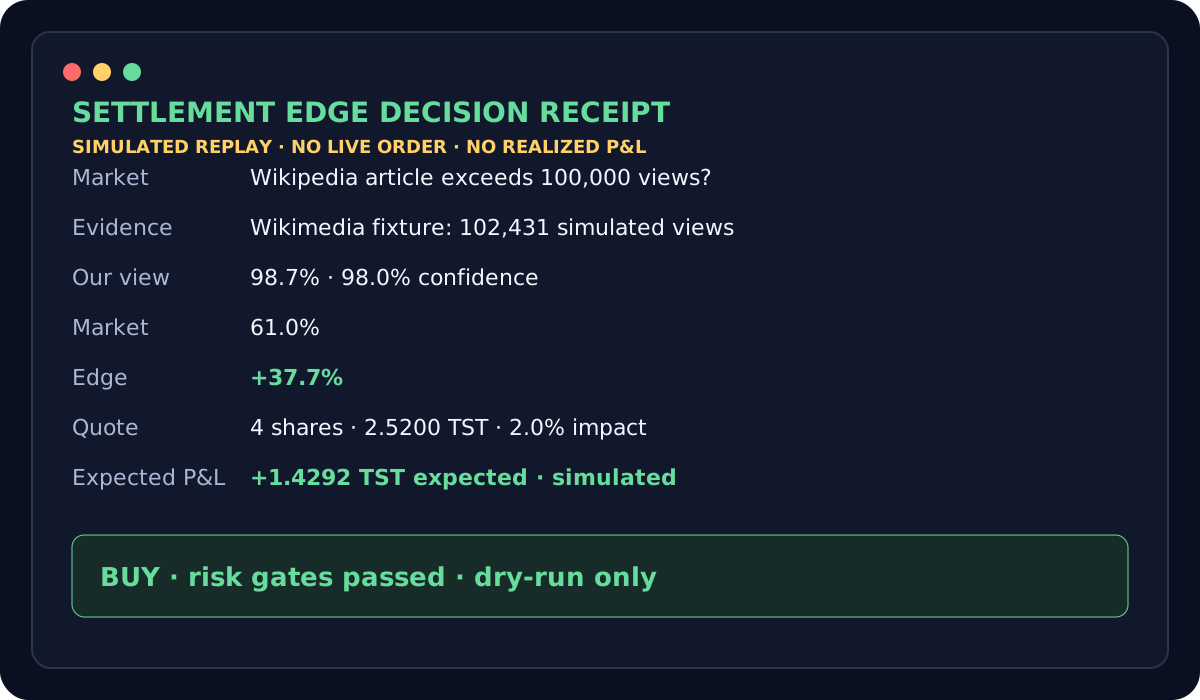
The checked replay produced a simulated four-share plan with 1.4292 TST expected P&L. That proves mechanics only. It is not a live result, profit claim, or rank.
Evidence and next read
- Verified competition closing record
- Machine-readable closing record
- How Settlement Edge works
- Source repository and tests
Observed result checked August 24, 2026. Replay remains simulation.